Kitchen Pepper

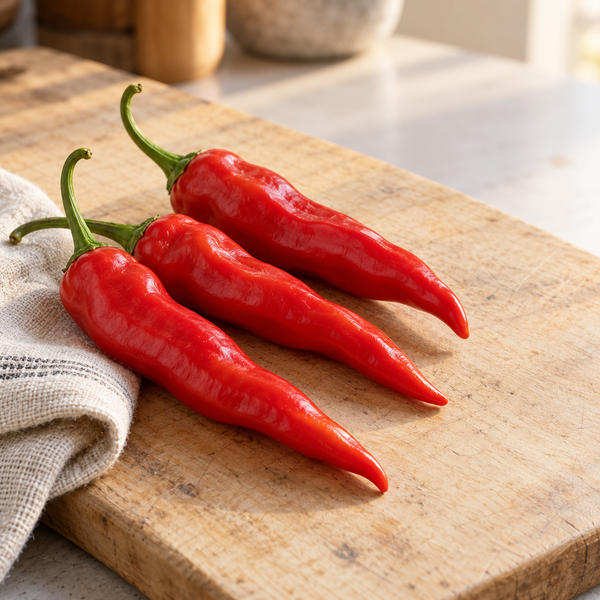
Padrón peppers are traditionally blistered in olive oil and finished with coarse salt. Their variable heat is part of their character: many pods are mild, but some can be hot.
CASA VERDE · HEAT PROFILE
Mild
- Sweet
- Mild — this variety
- Medium
- Hot
- Super hot
Scoville range awaiting confirmation.
Understanding the heat
A diamond marks the midpoint of a listed range, or the listed value when only one number is given. An arrow marks a stated limit. These are variety guides, not measurements of our seed lot. This guide uses unequal numerical bands: sweet 0; mild up to 10,000; medium 10,000–50,000; hot 50,000–800,000; super hot from 800,000 SHU (display capped at 3 million). Heat varies between fruits and with growing conditions.
No numeric marker is shown without a sufficiently clear range. For bundles, the highlighted categories refer to the different varieties.
A Scoville range has not been listed for this variety.
Shop all pepper seeds in Canada
- Origin
- Spain
- Season
- 2026
CASA VERDE · GROWER’S NOTES
Get to know your pepper.
The small frying pepper for a simple plate of tapas.
Padrón in the kitchen
Padrón peppers are traditionally blistered in olive oil and finished with coarse salt. Their variable heat is part of their character: many pods are mild, but some can be hot.
Why grow it?
Choose Padrón for a fast skillet dish rather than a large stuffed pepper. Cooking a batch lets you enjoy the blistered skins and tender flesh with very little preparation.
Kitchen notes
- Dry washed peppers well before adding them to hot oil.
- Cook in a single layer, turning until blistered and tender.
- Finish with coarse salt and serve promptly.
Planning your Canadian pepper garden
Start peppers indoors, harden off the plants gradually, and transplant after frost risk has passed and nights are reliably warm. Match your sowing plan to your local season and the variety, rather than a calendar date for all of Canada.
Explore the pepper collection
Questions about Padrón
Are all Padrón peppers mild?
No. Heat varies between pods. A fixed promise such as “one in ten is hot” is not a guarantee for your harvest.
Should I remove the stems before frying?
They are commonly left on as a handle when serving; discard the stems when eating.
Can I use them beyond tapas?
Yes. Grill or roast them as a side dish, or use them in a pickle.
Growing conditions affect harvest timing, flavour and heat. Variety descriptions are guidance, not a guarantee for every plant.
Also explore: the best pepper varieties for Canadian gardens
Cook your harvest
Use your harvest in these recipes. Check the variety notes and substitutions in each recipe.
Start indoors 8–10 weeks before last frost. Germinate at 26–30 °C on a heat mat; peppers stall below 22 °C. Pot up to 10–15 cm before hardening off outside after nights stay above 12 °C.
Feed balanced through bloom, then bump potassium for fruiting. Stake taller varieties. More detail in our full Canadian growing guide.
Match the pepper to the technique: thin-walled varieties blister fast in a hot pan; thick-walled ones roast or stuff beautifully; fruit-forward ones make balanced sauces and pickles. The variety's flavour profile is your shortcut — see Choosing the right pepper for a use-case guide.